
 Channel Manager
 Direct Booking Engine
 Metasearch
 Insights
 Dynamic Revenue Plus
 Channels Plus
 Property management system
 Payments
 Guest Engagement
 Mobile App
 Website Builder
 Hotel App Store
 Booking Channels
 Partner Programs
 Customer Stories
 Blog
Blog Templates
 eBooks
 Events

 English
 Reading time 5+ mins
To run a successful property, a hotelier must ensure that they maintain the highest quality and safety standards possible. But how? The answer is in standard operating procedures (SOPs).
Hotel SOPs form a playbook for running your property in a way that will keep guests safe and happy. They cover any and every aspect of your property: front desk operations, room cleaning, emergency drills and more.
In this blog, we will explore all that a small, independent hotelier should know about SOPs: what they are, why they’re important and how to implement them as part of effective small hotel management.
Less guesswork, more confidence
Implementing standard operating procedures at your small hotel can be tricky, but you can easily streamline SOPs with the help of Little Hotelier.
Learn more
What are small hotel standard operating procedures (SOPs)?
Small hotel standard operating procedures (SOPs) are documented, step-by-step instructions that tell staff exactly how to complete a specific task — from checking in a guest to responding to an emergency. They ensure every team member delivers the same standard of service every time.
SOPs can take a variety of forms that tend to be driven by the process they describe: a simple bullet-pointed list, a word-by-word script, or a detailed manual complete with pictures. The best SOPs are those that offer both detail and freedom, as this grants workers the flexibility they need to excel in their roles.
SOPs can (and should) be created for all hotel staff: front office, sales and marketing, customer service, food and beverage operations, housekeeping, maintenance, accounts and more. They should cover scenarios as common as room cleaning and as uncommon as emergency situations.
It’s not enough to simply develop an SOP. Perhaps the most critical step is in its implementation: conducting training to ensure all staff understand it and follow it.
Why are small hotel SOPs important?
Small hotel SOPs are important because they create consistency across every shift and every team member, even when the owner isn’t present. They protect you legally, reduce training time for new hires, and give your property a repeatable framework for delivering the kind of guest experience that earns five-star reviews.
When you consider the wealth of tasks undertaken at your small hotel, this importance becomes tangible. Think of when you last brought on a new employee and the number of jobs that they needed to learn, from those that are undertaken multiple times a day to those that may only come up once every few months. Documenting the best ways to do each of these tasks ensures that new team members can be quickly onboarded, and that they work efficiently and effectively from day one.
- Some SOPs are required by law, such as food safety procedures and emergency fire drills. If you fail to comply with regulations your business can face serious consequences, from a fine to a criminal prosecution.
- Some SOPs simply keep your hotel running, such as paying bills and conducting routine maintenance. If you want to avoid driving your hotel into the ground, these tasks need to be done consistently and correctly.
- And others are designed to separate your hotel from its competitors. These SOPs aren’t a box to be ticked or chore to be done – they’re a superpower. They can help you to enhance your service and create truly unique and truly memorable experiences – the sort that will have guests spreading the word and coming back for more.
Small hotel standard operating procedures are also important because hotels are really 24/7 operations, and owners and managers won’t always be on-site or easily contactable. Well crafted SOPs give all team members the tools they need to tackle any situation that might arise.
Key takeaways
- SOPs protect your business legally, operationally, and competitively. Treat them as essential, not optional.
- Documented procedures cut onboarding time and help new hires perform from day one.
- Well-designed SOPs also empower staff to deliver standout guest experiences even without direct supervision.
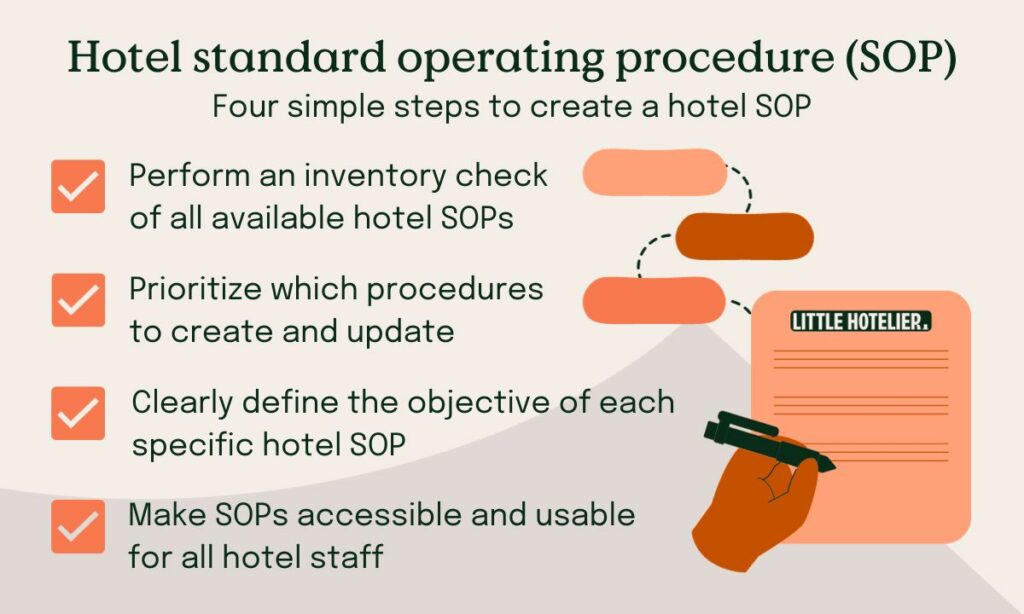
How do you create a small hotel SOP?
To create a small hotel SOP, you must first identify a recurring task and break it down into a series of clear, sequential steps that any staff member can follow. Documenting the process – ideally with photos and/or checklists – ensures that your standards are met, even when you aren’t there to supervise.
The measurable benefits of effective small hotel SOPs:
- 86% of buyers are willing to pay more for the better customer experience that SOPs can deliver.
- Employee turnover in hospitality often exceeds 70% annually, increasing the need for clear onboarding SOPs.
- Hotels that implement structured housekeeping checklists report reductions in guest complaints of up to 20–25%.
1. Do an SOP stocktake
Which procedures at your hotel don’t currently have an SOP that need one? Which procedures have an SOP that could be updated or improved? Are there any SOPs that unnecessarily restrict your team, where removing the safety rails could allow them to create an even better, more personalised guest experience?
Grab any SOP documentation that you might currently have, then get together with your team to answer these questions. Many hotel procedures become muscle memory over time, so a fresh set of eyes can be hugely beneficial during an SOP stocktake, whether from a new team member or a member of another department.
Prioritise the SOPs you need to create and update by importance and impact. If an SOP keeps your guests safe and your hotel running, it should be at the top of the list. Once those are knocked over you can begin to work on the SOPs that will separate your hotel from the rest by delivering incredible experiences.
2. Define your objective
No matter whether you’re creating or updating an SOP, you should start with the same question: what is the end goal? To successfully check someone in? To clean a room perfectly within a certain amount of time? To ensure all guests are safe and accounted for?
Defining the ultimate goal of a particular SOP allows you to move methodically back to the start, marking the steps to success along the way. You can also compare each of your steps to the objective, helping you to identify any that are missing or unnecessary.
An example: You want to improve your SOP for responding to discount requests. In doing so you ask your team how they currently respond. One worker says they have found success in asking guests whether they are part of your loyalty program, which offers a consistent discount to members. You realise that this is the best approach, so amend your SOP accordingly.
This approach also ensures you share the ‘why’ behind SOP changes with your team, making them far more open to the idea of doing things differently.
Take precious time back in your busy day
See how you can easily manage hotel operations, deliver a good guest experience, and attract more guests.
Watch a quick demo
3. Make your SOP usable and accessible
Once you’ve developed your SOPs it’s wise to do a few dry runs. These can identify any errors or oversights and ensure your SOP meets the goal set out at the beginning.
Ensure that your SOPs demand input from your staff – something as simple as checking a box – as this helps to set the right habits at the beginning, and gives you a record of compliance that you can look back on if issues arise.
An example: To ensure your room cleaning is consistent and done to a high standard, you create a small hotel housekeeping SOP. Instead of just a list of things to clean, you provide specific instructions on the order of cleaning tasks, cleaning technique, and how to deal with stains, damages and other tricky situations. You also include a photo of precisely how the room should look when the job is done, giving your housekeeping staff a visual reference that helps to ensure every guest enjoys a wow-level welcome.
Make your SOPs easily accessible. Place hard copies in your office filing cabinet and digital copies in your computer system, and consider putting the most common/important, such as check-in and phone SOPs, up on the walls of your workspace.
Key takeaways
- Begin with a stocktake: identify which tasks lack SOPs and which existing SOPs need updating.
- Define the end goal of each procedure first, then work backwards to map out each step.
- Test your SOPs with dry runs, make checklists interactive, and keep them visibly accessible.
What are the key areas of SOPs for each small hotel department?
What are the key areas of SOPs for each small hotel department?
The key areas of SOPs for a small hotel typically span seven departments: front office, back office, food and beverage, housekeeping, maintenance, guest experience and reputation management, and safety and emergency. Because staff at smaller properties often wear multiple hats, with an owner doubling as front desk manager or a housekeeper covering maintenance, clear SOPs for each area help everyone switch between roles without dropping standards.
By categorising these procedures, you ensure that every facet of the business operates with the same level of precision and care.
Small hotel SOP efficiencies by the numbers:
- Structured onboarding, including clear SOPs, improves new hire retention by 82% and productivity by over 70%.
- Hotels using digital task management tools see 10-15% improvements in labour productivity.
- Hotel SOPs can cut new employee training time by nearly half.
SOPs for front office
In a small hotel, the front office is where first impressions are made and guest relationships are solidified. Standardising these interactions ensures a professional and warm welcome every single time.
- Check-in and check-out: Steps for verifying IDs, processing payments and capturing guest data.
- Reservation management: How to handle phone bookings, modifications and cancellations to avoid overbooking and other issues.
- Payment handling: Clear instructions on processing deposits, handling cash and managing card security compliance.
Small hotel check-in SOP template:
- Greet: Welcome guest by name if possible.
- Verify: Confirm booking details and request ID.
- Key: Issue room key and explain property amenities (breakfast times, Wi-Fi password).
- Help: Offer luggage assistance and local recommendations.
SOPs for back office
Back office SOPs keep the administrative side of your small hotel running smoothly, ensuring bills are paid, staff are well managed, and the property is profitable.
- Daily night audit: A step-by-step guide to reconciling the day’s sales and rolling the date over in your PMS.
- Supplier management: Procedures for receiving deliveries and managing invoices to maintain healthy cash flow.
- Reporting: Weekly or monthly checklists for reviewing occupancy rates and revenue performance.
Small hotel invoicing SOP template:
- Review: Match the delivery note against the original purchase order.
- Record: Enter invoice details into the accounting system.
- File: Store a digital or physical copy for tax purposes.
SOPs for food & beverage
From simple breakfast spreads to honesty bars, F&B SOPs are essential for maintaining hygiene standards and controlling costs at a small hotel.
- Breakfast service: Instructions for table setup, food presentation and managing the dietary requirements of your guests.
- Food safety: Strict cleaning schedules for the kitchen area and daily temperature logs for fridges.
- Inventory control: How to stocktake beverages and dry goods in an effort to minimise waste.
Small hotel honesty bar SOP template:
- Check: Inspect the bar area every morning for empty bottles and used glasses.
- Restock: Replenish snacks and drinks based on the par-level list.
- Tally: Record items used against the guest’s room number in the PMS.
SOPs for housekeeping
In a small hotel, cleanliness is often the most cited factor in guest reviews. Housekeeping SOPs ensure that no detail – from the remote control to the bathroom tiles – is overlooked.
- Room turn sequence: A logical flow – such as clockwise or air/bed/circulation/dust (ABCD) – to ensure the whole room is cleaned efficiently.
- Linen management: Procedures for sorting, washing and storing linens to prevent damage.
- Deep cleaning: A rotating schedule for tasks like steam-cleaning carpets or washing curtains.
Small hotel housekeeping SOP template:
- Strip: Remove all used linens and towels.
- Sanitise: Clean bathroom surfaces and high-touch points (light switches/remotes).
- Reset: Make the bed and replace amenities according to the brand standard.
SOPs for maintenance
Preventative maintenance is especially critical for small hotels looking to avoid expensive emergency repairs. These SOPs help you keep your property in top condition year-round.
- Routine inspections: A monthly walkthrough to check for leaking taps, blown bulbs or fraying carpets.
- Equipment servicing: Scheduled reminders for boiler checks and air conditioning filter changes.
- External upkeep: Seasonal tasks like clearing gutters or maintaining garden pathways.
Small hotel lightbulb check SOP template:
- Inspect: Test every light switch in the room during the weekly maintenance walk.
- Replace: Use the correct wattage/colour-temperature LED bulb.
- Report: Note the replacement in the maintenance log.
SOPs for guest experience & reputation management
For a small hotel, managing your online presence and guest feedback is critical for attracting future bookings. These SOPs ensure you maintain your reputation.
- Review responses: A guide on how to thank guests for positive reviews and professionally address negative feedback.
- Guest communication: Templates for pre-arrival emails and post-stay thank you notes.
- Complaint resolution: The steps staff should take to resolve an issue on-site before the guest checks out.
Small hotel review response SOP template:
- Acknowledge: Thank the guest by name for their feedback.
- Personalise: Mention a specific detail from their stay.
- Action: If negative, explain the steps taken to fix the issue and offer a follow-up.
SOPs for safety & emergency
While they’re hopefully never needed, safety SOPs are the most important documents in your small hotel, as they protect both you and your guests from harm.
- Fire safety: Procedures for testing alarms and conducting evacuation drills.
- Emergency contacts: An easily accessible list of local police, fire and medical services.
- Power outages: Instructions on where to find torches and how to manually operate locks or gates.
Small hotel fire alarm SOP template:
- Locate: Identify the zone on the fire panel.
- Investigate: Check the area for signs of fire (if safe to do so).
- Evacuate: Direct guests to the assembly point and call emergency services.
Key takeaways
- SOPs ensure every staff member delivers the same high standard of service even when you are off-site.
- Start by defining the end goal of a task to identify the most efficient steps to success.
- Make checklists easy to follow, and keep them visible and easy to access.
How do you implement and maintain SOPs at a small hotel?
To implement and maintain SOPs at a small hotel, start by training your team on each procedure and focusing on the ‘why’ behind every step. Keep documents short, visual, and accessible, then schedule quarterly reviews to update them as your property and guest expectations evolve.
Every small hotel is different, so your SOPs will naturally look different too. But three universal principles will set you up for success:
- Train to empower: SOPs form the playbook for dealing with situations that occur on your premises, but ensure there is wriggle room where appropriate. Your SOP training should make your staff feel entrusted and empowered.
- Short and punchy: Deliver instructions as efficiently as possible while still going into the necessary detail. Visuals like photos and flow charts can help.
- Review and refresh: Your SOPs are never ‘complete’. Establish a regular review schedule, such as every three months, and update your SOPs where required.
Key takeaways
- Train staff on the reasoning behind each SOP so they feel empowered rather than restricted.
- Keep SOP documents short, visual, and easy to access. Wall-mounted checklists work well for high-frequency tasks.
- Schedule quarterly reviews to keep SOPs aligned with evolving guest expectations and operational changes.
Frequently asked questions about small hotel standard operating procedures
How often should hotel SOPs be updated?
Small hotel SOPs should be reviewed at least once every quarter. Beyond that regular cadence, you should also revisit specific SOPs whenever there is a significant change, such as new staff joining the team, a shift in local regulations, the introduction of new technology like a PMS, or recurring guest complaints that point to a process gap. Treat your SOPs as living documents: the more consistently you review and refine them, the more useful they remain for your team.
How can I get my hotel staff to follow SOPs?
The most effective way to get staff to follow SOPs is to involve them in the creation process. When team members help shape the procedures, they understand the reasoning behind each step and feel a sense of ownership. Beyond that, keep SOPs short and visual. Checklists, photos, and flowcharts are far more likely to be used than dense manuals. Reinforce SOPs during team briefings, recognise staff who follow them well, and make sure documents are physically accessible where the work happens, not buried in a filing cabinet.
How do SOPs improve guest experience and operational efficiency?
SOPs improve guest experience by ensuring every interaction meets the same high standard, regardless of which staff member is on duty. Guests notice the consistency, and it shows up in reviews and repeat bookings. On the operational side, SOPs reduce the time spent training new hires, minimise errors that lead to costly fixes, and free up managers to focus on strategic tasks instead of firefighting. Together, these benefits create a cycle where better operations lead to happier guests, which in turn drives more revenue.

By Dean Elphick
Dean is the Senior Content Marketing Specialist of Little Hotelier, the all-in-one software solution purpose-built to make the lives of small accommodation providers easier. Dean has made writing and creating content his passion for the entirety of his professional life, which includes more than six years at Little Hotelier. Through content, Dean aims to provide education, inspiration, assistance, and, ultimately, value for small accommodation businesses looking to improve the way they run their operations (and live their life).
Table of contents


Free ebook
The ultimate A-to-Z guide to Little Hotelier
“My experience with Little Hotelier has been fantastic due to the ability of managing all channels in one place. It made my business more professional.”
Owner, Forgandenny House B&B



Saban Demirbasa,
Head of Hospitality and Branding
Stone Court House