
 Channel Manager
 Direct Booking Engine
 Metasearch
 Insights
 Dynamic Revenue Plus
 Channels Plus
 Property management system
 Payments
 Guest Engagement
 Mobile App
 Website Builder
 Hotel App Store
 Booking Channels
 Partner Programs
 Customer Stories
 Blog
Blog Templates
 eBooks
 Events

 English
 Reading time 5+ mins
What is upselling in hotels?
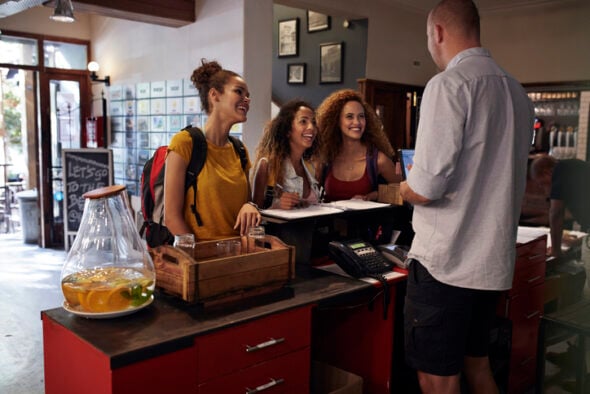
Hotel upselling is a sales technique in which guests are encouraged to upgrade to a premium room or choose more premium extras within an existing reservation. A small hotel, for example, might offer a room with a private balcony for an extra $30 per night during the online booking process or at check-in.
Upselling is distinct from cross-selling, which involves offering complementary but entirely separate extras; non-room revenue streams such as spa treatments, local tours, souvenir sales and partnership commissions. Cross-selling is considered an ancillary revenue strategy, while upselling is a strategy that works to maximise revenue from your core rooms and services.
Upselling in small hotels works best when you have some knowledge of what the customer is interested in and what they will see as valuable. It allows you to make more revenue from each individual reservation, so you don’t need to max out your occupancy in order to make a profit.
Upselling can also increase the level of personalisation you offer your guests. The products you could upsell include your rooms, access to amenities, on-site services, or consumables like food and beverages.
In this guide we’ll take you through the keys to upselling in small hotels.
Why is upselling in hotels important?
Upselling allows small hotels to make more money without needing to sell more rooms. Small hotels can’t just add extra room inventory – at least not quickly or easily – so maximising the value of each booking is the most efficient way to lift your property’s financial ceiling and improve overall profitability.
Upselling is a core component of broader revenue management for small hotels, where pricing, distribution and forecasting combine to optimise revenue from limited inventory. It’s an opportunity to capitalise on current trends: data shows that 58% of guests are now choosing superior or luxury rooms over standard when given the option. Tailored offers also deepen guest relationships because personalised additions demonstrate care and attentiveness to specific travel needs.
This willingness to spend on higher-value rooms, longer stays and extras has helped to drive the average booking value up in recent times. This effect is particularly pronounced on direct hotel booking websites, which generated an average of US$516 per booking in 2025, versus US$312 for OTA bookings. This reflects the control over upselling a small hotel enjoys when they own the booking process, and the fact that direct reservations don’t incur OTA commission fees.
Upselling is one of a small hotel’s most accessible levers for growing revenue per available room (RevPAR). For the full breakdown of how this metric works and other ways to improve it, see our RevPAR guide for small accommodation providers.
Turn every booking into an upsell opportunity
Little Hotelier's Guest Engagement tools deliver the right upgrade offer at the right moment, automatically, so you capture more revenue from every guest.
Learn more
When should you upsell guests during the booking journey?
Key traveller spend insights:
- Despite being conscious of costs, modern travellers are willing to pay a premium for elevated and memorable experiences.
- Guests enrolled in a loyalty programme are lucrative, with data showing that these loyal customers spend 22.4% more and stay 28% longer than non-members.
The timing of an upsell offer is at least as important as the offer itself. Presenting an upgrade when a traveller is not in a buying mindset causes friction and can actively harm your relationship, but a well-timed suggestion is more likely to succeed, and can make them feel like you truly care. To maximise revenue, operators must target three distinct phases of the guest journey.
1. Pre-arrival hotel upselling
This phase has the highest potential for automation, which means you can make sales in your sleep. It begins at the point of reservation. You can incorporate upgrades and packages directly within your direct booking process using a tool like Little Hotelier’s booking engine, prompting guests to enhance or customise their stay when they make their reservation. Pre-stay SMS and email offers are also effective – because the core room cost was settled weeks or months prior, guests can be less price-sensitive and more receptive to upselling during this window.
2. Front-desk arrival upselling
When the guest arrives, your upselling strategy shifts from digital to human. Front-desk staff can make upgrade offers based on whether they’re welcoming a corporate traveller, a family or a couple: the latter, for example, might appreciate a room with a spa bath during a romantic weekend away. Upselling at this point can be treated as a bonus, allowing you to offer premium inventory that would otherwise sit empty, at a fraction of the standard rate – you make more money, they get a great last-minute deal. This makes the offer feel more like a high-value perk than a sales pitch.
3. In-stay hotel upselling
Upselling doesn’t end when the guest gets their room key. During their stay, concierge-style add-ons that are customised to the guest’s preferences form a significant revenue opportunity. If they’ve booked a dinner at your in-house restaurant, upgrade them to a tailored chef’s menu. If they’ve mentioned they have an afternoon flight, offer them a late checkout. By paying attention to what guests say and how they interact with your property, small hotels can deliver highly relevant, real-time suggestions that enhance the daily experience while capturing more spend.
What are the most effective hotel upselling techniques?
The right upselling technique depends on the profile of a guest, the context of their stay, and what your property can realistically offer. These six techniques cover most small-hotel scenarios, from check-in room upgrades to mid-stay extensions.
Here are a few proven techniques for upselling in small hotels.
- Room upgrades at check-in
Room upgrades are the most profitable upsell category because the physical inventory is sitting there ready to be used, so there’s no extra cost involved (apart from the initial investment in converting standard rooms to superior or luxury options).
If premium rooms are empty, look at your arrivals list and pair incoming guests with potential upgrades based on what you know about them. For families, consider offering a second interconnecting room at a discounted rate, such as 30% off, to give them extra space. For couples, suggest an upper floor room with a better view, or one featuring premium amenities like a spa bath.
- Pre-arrival package upsells
A great way to boost spend is to combine rooms with services and add-ons within exclusive packages. Bundling a base room with high-value extras is a highly effective way to increase total booking value before the guest even sets foot on your property. You can design packages that combine accommodation with a daily breakfast, late checkout or welcome drink.
To make these offers tempting it’s important to price the bundle below the individual sum of its parts, to show the guest they’re getting value. This flexible tactic should form a core part of broader hotel pricing strategies.
- Event and occasion upsells
There are plenty of upsell opportunities to be found within corporate bookings and special events. Event organisers are prime candidates for targeted upgrades because they are less price-sensitive and want their attendees to have an unforgettable experience – they’re willing to pay extra if the addition truly enhances the quality of their gathering.
You could rent audiovisual equipment, design premium catering menus, or connect the booker with service providers like MCs, DJs, celebrants and auctioneers and take a commission. Business travellers, meanwhile, appreciate rooms with desks, communal meeting spaces, and somewhere to socialise in the evening.
- Partnership-driven extras
By collaborating with local businesses you can diversify your revenue streams with minimal effort and zero upfront investment. Strike agreements with transport providers to offer airport transfers. Partner with nearby day spas and tour guides, then sell tickets directly to guests.
You enjoy a nice little commission on each sale, and the operational risks and costs are non-existent. Guests are typically willing to pay a premium for these services because you save them the time, effort and anxiety of vetting local operators.
- Local product packs
For independent B&Bs and boutique hotels, personal touches and regional connections are primary USPs. Contact regional suppliers to curate exclusive product hampers containing high-end items like wine, cheese, desserts or handmade beauty products. Place these custom packs in rooms prior to arrival to deliver the warmest of welcomes.
This tactic positions your hotel as a local authority, and can drive retail sales at your front desk if you offer full-size versions of the sample products you gave your guests.
- In-stay upgrades and extensions
Upselling should continue through the stay. Monitor your guests and present relevant offers at critical moments. If a premium room suddenly becomes available due to a late cancellation, send a prompt offering a mid-stay room upgrade for their remaining nights. Send through a deal for your on-site restaurant in the mid-afternoon, when they’re deciding what they’ll have for dinner. You could even send an automated pre-arrival alert on Thursday evening that offers a special long weekend rate to encourage guests to extend their stay by an extra night. This dynamic approach ensures you capture every possible revenue opportunity, capitalising on the fact that many travellers are willing to pay extra for a more memorable experience, frequently opting to upgrade to deluxe rooms.
Key takeaways
- Tailor upsell offers to specific guests and travel motivations to maximise conversions.
- Tempting pricing on empty premium rooms at check-in can capture high-margin revenue from otherwise wasted inventory.
- Grouping accommodation with discounted extras in packages can increase total booking value.
What’s an example upselling script for hotel staff?
An effective upselling script should never feel like a sales pitch. It should instead focus on the guest experience. Treat the examples below as flexible templates to be adapted and customised based on the tone and context of each guest conversation.
Check-in room upgrade script
This template provides front-desk staff with a structured way to present premium inventory face-to-face during arrival:
“Welcome to [Hotel Name], [Guest Name]! We are delighted to have you with us for your stay.
Your booking for a standard double room this weekend is a fantastic choice. However, I wanted to mention that our signature King Ocean Suite is available for your two-night stay. This upgrade offers a private balcony, twice the floor space, and your own complimentary espresso bar.
While this suite is usually priced at a much higher rate, I can offer you this upgrade for only an additional $25 per night since it is available this evening. Would you like to treat yourself?”
Pre-arrival email upsell script
This short text template is designed for an automated email or SMS sent 3-5 days prior to arrival:
Subject: Customise your upcoming stay at [Hotel Name]
Dear [Guest Name],
We’re looking forward to welcoming you to [Hotel Name] on [Arrival Date]. To help you have the most memorable stay possible, we’ve put together a few optional extras to enhance it.
Many of our guests enjoy adding a regional snack hamper on arrival ($30), or treating themselves to a late checkout at 1:00pm ($15). If you’d like to add either of these to your booking, simply reply to this email or update your reservation online.
Travel safely, The Team at [Hotel Name]
In-stay extension or upgrade script
This brief conversation can be had face-to-face or via message midway through a guest’s stay:
Good morning, [Guest Name]. We hope you are thoroughly enjoying your time in the deluxe studio leading up to checkout on Sunday.
Our signature Garden Penthouse has unexpectedly opened up for your remaining two nights due to a scheduling change. As a valued current guest, we’d like to present a special offer: we can apply a 50% discount to the room upgrade fee – that’s just $35 extra per night!
We can transfer your belongings over to that room this afternoon. Would you be interested in penthouse views for the rest of your stay?

What hotel upsell software should small hotels use?
Small hotels don’t need a dedicated upselling tool. Effective, automated upselling instead relies on an integrated software stack that combines guest engagement, a booking engine and a front-desk system that gives you eyes on your guests and room inventory. The right tool will cut down front-desk admin, freeing your staff up for the high value work of enhancing guest stays through special deals and offers.
The best tools are made up of four distinct technical layers.
1. Guest engagement and messaging tools
A dedicated guest communication tool is the most critical driver of an automated hotel upsell program. Modern guest engagement platforms let you create and automatically deliver upgrade offers at the precise moment a guest will be most open to the opportunity. They can also track long-term upsell performance over time to help you improve.
These tools allow you to segment communications by traveller type, ensuring families receive activity add-ons, and business guests receive business centre offers. Little Hotelier’s Guest Engagement feature is built around this exact concept, bundling all this functionality into a single, simple interface.
2. Booking engine with add-on capability
A direct booking website not only allows you to avoid sky-high OTA commission fees – it gives you total control over how and what you upsell. Before completing their reservation, a guest should be presented with a menu of packages, transport options, local experiences, room upgrades and welcome gifts they can add in a single click. These are sales that you can make without lifting a finger, and which can greatly enhance the experience that the guest enjoys at your hotel.
3. PMS and front-desk system with guest profiles
Your property management system is the technical foundation that allows your messaging and booking tools to function smoothly. You can maintain profiles that tell you the exact upgrades that a specific guest will be interested in based on booking details and past interactions. Real-time room visibility, meanwhile, helps front-desk staff see which premium rooms are empty and ready to be offered as upgrades. Little Hotelier’s property management system bundles these records and calendars into a single, cohesive view.
4. AI-powered personalisation features
Consider capitalising on AI to predict guest needs and behaviours, then upselling based on those insights. These emerging tools analyse historical data to recommend high-conversion upgrades for every booking, an approach increasingly seen as standard practice across the wider hotel industry. For the moment, AI personalisation is far from a must for small hotels, who may be better served by nailing the use of their messaging, booking engine and property management tools.
How do you measure hotel upselling success?
Three upselling metrics matter more than the rest: upsell capture rate, average upsell value, and revenue per available room/guest (RevPAR/RevPAG). Because most small properties don’t monitor these data points, even the most basic tracking, like whether the numbers are moving up or down, can give your property a significant advantage over your independent competitors:
- Upsell capture rate: This metric reveals the percentage of total guests who upgrade their room or make an additional purchase. Tracking this rate helps you identify which offers resonate best, and whether your front-desk team requires additional coaching to pitch upgrades effectively.
- Average upsell value: Calculate this metric by dividing your total monthly upsell revenue by the number of guests who accepted an offer. This figure indicates the average amount of secondary spend generated per transaction, which helps you ensure your packages and add-ons are priced optimally.
- RevPAG and RevPAR lift: RevPAG tracks the total revenue generated per available guest, making it the ultimate metric for measuring ancillary sales success. RevPAR captures the revenue lift from successful upsells across all rooms. If these numbers go up, it’s a good thing. (For the full formula, benchmarks and strategies to improve it, see ourRevPAR guide for small accommodation providers.)
Tracking upsell revenue is only half the picture. You also need to understand the upsell costs to gain a picture of profit. Offering your penthouse suite for $5 extra per night doesn’t make you $5 more profit, because the larger room costs more to clean and maintain. For formulas that calculate true financial and operational efficiency, see our guide to flow through for small hotels.
Frequently asked questions about hotel upselling
What is the difference between upselling and cross-selling in hotels?
Upselling encourages a guest to purchase a more premium version of their original choice, like upgrading from a standard double room to a luxury king suite. Cross-selling involves offering entirely separate complementary products or services, like an airport transfer or a bottle of wine on arrival.
When is the best time to upsell hotel guests?
The best time to upsell is not a specific moment, but across three windows: pre-arrival, at check-in and mid-stay. Each window targets a different buyer mindset: automated pre-arrival emails can drive zero-effort sales, check-in conversations can secure on-the-spot room upgrades, and mid-stay prompts can capture late checkouts. See our detailed breakdown above.
How do you upsell without being pushy?
The secret to seamless upselling is the mindset: this isn’t a sales pitch – it’s a chance to enhance the guest experience. Frame upgrades as relevant and exclusive opportunities to enjoy a more memorable stay. If the guest declines, accept the answer with a smile so the interaction always feels like attentive service.
Can small hotels automate upselling without expensive software?
Small hotels don’t need expensive tools to upsell. Most properties can begin to automate their upselling strategies using their existing software stack, such as setting up add-ons in their booking engine or scheduling automated pre-arrival messages using guest engagement tools.
How do you train front desk staff to upsell effectively?
Effective training should include script templates, roleplay situations and potential incentives based on performance. Front-desk teams should be taught to review daily arrivals lists, identify the premium inventory that’s available, and match those empty rooms with incoming guests.
Does AI play a role in hotel upselling?
Artificial intelligence is playing a growing role in upselling, as it can be used to analyse past booking behaviours to predict the exact timing and types of offers most likely to convert. But for small hotels with limited inventory, non-AI upsell strategies can be every bit as effective.

By Dean Elphick
Dean is the Senior Content Marketing Specialist of Little Hotelier, the all-in-one software solution purpose-built to make the lives of small accommodation providers easier. Dean has made writing and creating content his passion for the entirety of his professional life, which includes more than six years at Little Hotelier. Through content, Dean aims to provide education, inspiration, assistance, and, ultimately, value for small accommodation businesses looking to improve the way they run their operations (and live their life).
Table of contents


Free ebook
The ultimate A-to-Z guide to Little Hotelier
“It's been a huge time-saver for me. It's convenient to swipe through all the rooms and make a new booking. I'm having a fantastic time with it.”
Operational Manager, Samui Bayside


Mick Comerford,
General Manager
The Mercantile Hotel