
 Channel Manager
 Direct Booking Engine
 Metasearch
 Insights
 Dynamic Revenue Plus
 Channels Plus
 Property management system
 Payments
 Guest Engagement
 Mobile App
 Website Builder
 Hotel App Store
 Booking Channels
 Partner Programs
 Customer Stories
 Blog
Blog Templates
 eBooks
 Events

 English
 Reading time 5+ mins

What is hotel flow through?
Hotel flow through is a financial metric that measures the percentage of incremental revenue – whether generated through room bookings, upselling or ancillary streams – that converts directly into profit. While top-line metrics like revenue per available room (RevPAR) track gross earnings, flow through calculates marginal efficiency. It reveals how effectively a property converts extra turnover into profit, and therefore forms a core pillar of revenue management for small hotels.
Flow through shows whether or not your extra income is being eaten up by rising operational expenses. It provides a clear view of performance during periods of fluctuating demand, allowing independent hoteliers to see exactly how expenses change when booking volumes shift.
If a small property generates more revenue this month than it did during the same period last year, flow through calculates how much of that surplus remains after covering immediate variable costs like extra housekeeping, laundry and utilities. It is a vital profitability indicator that helps independent operators spot underlying cost inflation that can go unnoticed when the focus is on filling rooms.
Monitoring this metric allows independent hoteliers to move away from guessing about profitability and start making data-driven decisions. By tracking these shifts over time, property owners can confidently evaluate whether their baseline pricing structures, marketing initiatives and daily operational workflows are delivering genuine financial results.
In this article, we’ll show you what you need to know about flow through within your business, how it impacts your success, and how you can improve it with smart investments.
Master your flow through with Little Hotelier
Track your revenue, manage costs, and keep more of your profit with tools made for small hotels.
Learn more
Why is flow through important for small hotels?
RunFlow through is critical for small hotels because it gives you a view of your true profitability. It offers the feedback you need to make you more disciplined with costs, and it verifies the quality of your business decisions. For independent hoteliers tasked with handling operations without a financial analyst, this metric helps to ensure that your efforts actually translate into a healthier bank balance.
Focusing just on top-line revenue can paint a misleading picture of a hotel’s financial health. Analysing flow-through delivers three key strategic benefits:
1. Profit visibility beyond top-line revenue
Small hotels can feel a false sense of security during peak seasons. But a fully booked month may not make you as much money as you think if that high occupancy leads to a spike in utility bills, extra staff hours or the endless use of consumables. Flow through acts as an early warning system against profit margins being eroded by extra costs, by showing you exactly how much extra money remains after guests leave and expenses are accounted for.
2. A feedback loop on cost discipline
Flow through tells you how well you’re managing your variable costs, so you can maximise your profit at busy times and manage your finances at quiet times. When you understand how your expenses change with your occupancy, you can make adjustments to staffing and procurement without negatively affecting the guest experience. Tracking flow through creates a feedback loop where small tweaks keep your business efficient and help you to hold onto a larger chunk of every dollar you earn.
3. Knowing what is actually working
Tracking incremental profit tells you whether a new promotion, rate adjustment or operational initiative is doing what you hoped it would do. If you launch a targeted campaign for upselling in your hotel, for example, or perhaps introduce a new ancillary revenue stream like an on-site bar, flow through tells you if that extra revenue is turning into profit, or is simply money down the drain. If revenue climbs but your flow-through percentage stays flat or drops, it’s a clear sign that the cost of delivering those extras is too high.
How do you calculate flow through in a hotel?
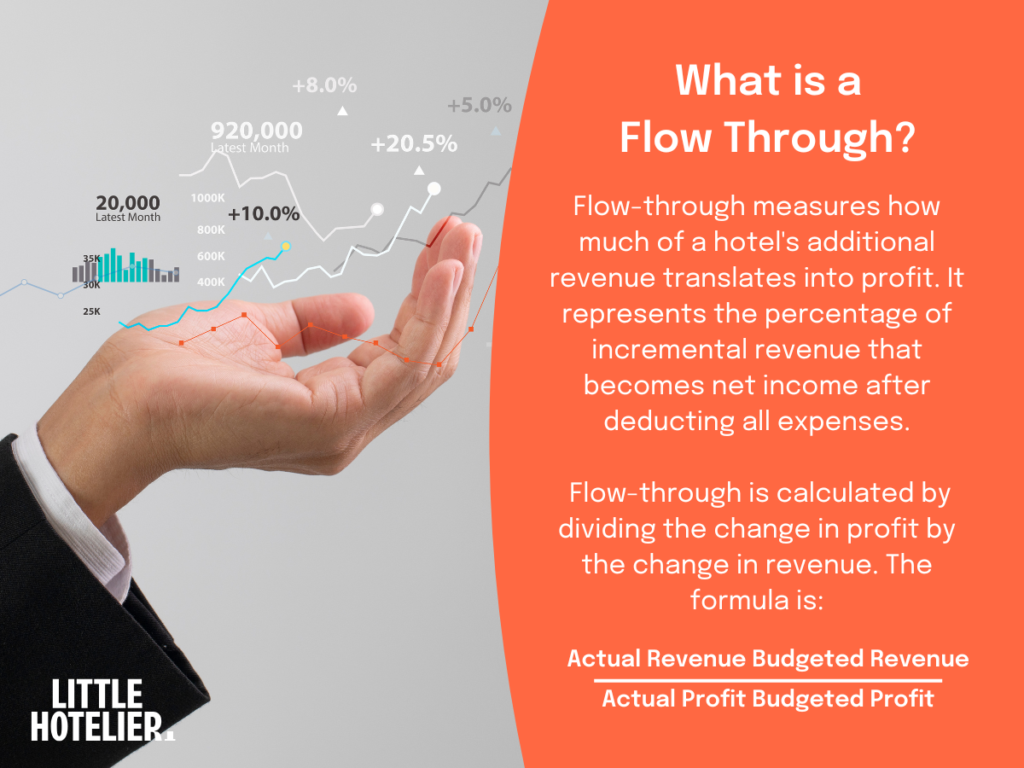
To calculate hotel flow through, divide the change in profit between two financial periods by the change in total revenue over that same timeframe, then multiply by 100 to express that result as a percentage. This calculation tells you exactly what portion of every additional dollar earned is retained as profit rather than being absorbed by costs, giving you deep insight into the efficiency of your business decisions and operations.
Flow Through (%) = (Actual Profit – Budgeted/Last Period’s Profit) ÷ (Actual Revenue – Budgeted/Last Period’s Revenue) × 100
As the formula indicates, you can evaluate how your income shifts compared to historical data or targets/budgets that you set yourself.
Small hotel profitability by the numbers:
- The financial performance of hotels globally is forecast to rise modestly in 2026, driven primarily by rate increases rather than occupancy, with average daily rates (ADR) expected to grow by 1–2%
- Retaining guests is highly effective for driving revenue; loyal customers spend 22.4% more and stay 28% longer.
- To combat persistent labour shortages and maintain operational flow-through, 30% of hoteliers have increased their investment in automation over the last six months.
Understanding the different variations of the flow through formula allows you to assess both past and expected performance.
Standard flow through formula and worked example
The standard calculation compares your actual operational performance against your original budget or a previous baseline year. This straightforward approach helps you to understand how to increase hotel revenue sustainably without overcomplicating your monthly bookkeeping.
Suppose your actual monthly revenue was $25,000 against a budget of $20,000, creating a revenue increase of $5,000. Over that same month, your actual profit reached $10,000 compared to a budgeted target of $8,000, yielding a profit gain of $2,000.
- ($10,000 – $8,000) ÷ ($25,000 – $20,000) × 100 = Flow Through %
- $2,000 ÷ $5,000 × 100 = 40%
In this case, 40% of your incremental revenue successfully converted into profit, while the remaining 60% was spent covering the costs of those additional bookings.
Most small hotels aim for a flow through of 35-60%, though this can vary significantly by hotel and even season. A lower result (e.g. below 35%) suggests that rising costs are eroding profit, while a high percentage (e.g. above 60%) means you’re keeping most of those financial gains, though it’s worth checking that you’re not under-investing in the guest experience.
How is GOP flow through different?
Gross operating profit (GOP) flow through is the metric typically used by the hospitality industry. While the standard formula above can apply to any profit line on a balance sheet, GOP flow through encompasses the hotel’s revenue and profit as a whole, including room, upselling and ancillary earnings.
GOP Flow Through (%) = (Current Period GOP – Prior Period GOP) ÷ (Current Period Revenue – Prior Period Revenue) × 100
Using the same figures as our example above, if your property’s GOP increases by $2,000 on the back of a $5,000 rise in total revenue, your GOP flow through sits at 40%. International benchmarking firms use this version to evaluate institutional hotel performance, but for day-to-day use the standard take on the formula remains the preferred and highly practical option.
What is flex (the flow through counterpart)?
Flex measures your operational efficiency in the opposite direction, tracking how much profit a hotel manages to protect when revenue drops during a seasonal decline or an unexpected dip. It calculates your ability to reduce variable costs in proportion with lower occupancy, to shield your hotel’s finances in tough times.
Let’s say, your small hotel experiences a quiet month where total revenue drops by $5,000. If you don’t adjust your costs, profit will automatically drop by the full $5,000. But by trimming staff schedules and reducing consumable use you can restrict the actual profit drop to $2,000 through cost savings.
Of the $5,000 in lost revenue, $2,000 became lost profit (that’s a 40% flow through). The remaining $3,000 was protected through cost cuts, which is a 60% flex. Together they account for the entire revenue drop.
Key takeaways:
- Flex measures the operational capacity to protect profitability by cutting costs when hotel revenue declines.
- Dividing incremental profit by incremental revenue determines the exact percentage of new turnover you keep.
- Most independent properties target a flow-through benchmark of 35% to 60%.
How can small hotels improve flow through?
Small hotels can improve their flow through percentage with a strategy that generates high-margin revenue while maintaining strict cost controls. While ‘make more money while spending less’ is easier said than done, fixed overheads like rent and base salaries are at least constant, which gives independent properties an opportunity to convert maximum profit by optimising the following four levers.
- Tighten pricing to capture more revenue per booking: Room rate increases applied during peak periods convert almost entirely into profit because your core operational costs should already be covered by your base room rate. Raising your average daily rate by even a small amount requires no additional labour or inventory, ensuring that extra turnover flows directly to your bottom line. (For rate-setting guidance for small hotels, see our guide to hotel pricing strategies.)
- Upselling and package bookings: Offering room upgrades, package deals and premium amenities can lift the value of individual bookings without huge increases in operating expenses. This approach focuses on capturing more cash from travellers who are already staying at your property – a captive audience who are often ready to spend. (For tactics that lift booking value, see our guide to upselling in hotels.)
- Build ancillary revenue streams alongside rooms: Introducing services like a bar, event hire or a local tour agency partnership establishes revenue streams that are separate from your limited number of rooms, and allow you to make far more money per guest (and in the case of food and beverage, potentially non-guests too). All the while, your primary fixed costs remain safely covered by room sales. (For info on small hotel ancillary revenue streams, see our guide to ancillary revenue for small hotels.)
- Control variable costs as occupancy rises: Expenses like extra housekeeping hours, guest supplies and utilities can quickly rise during busy times if you don’t actively manage them, which erodes your margins. The most effective countermeasure is to adjust your roster so you only have extra staff when you genuinely need them, rather than relying on fixed weekly schedules.
What tools help small hotels track flow through?
Tracking flow through effectively requires specialised software capable of recording live revenue performance, capturing shifting variable expenses and delivering automated financial reporting. A connected software ecosystem lets you say goodbye to spreadsheets and manual data entry, automating all manner of previously laborious tasks so you can enjoy total visibility over the costs and profits of your hotel.
But this all rests on choosing software that provides specific tracking capabilities. When choosing your tool, focus on platforms that deliver functionality across four core operational areas:
1. Real-time revenue tracking
Knowing exactly how much you’re earning day by day helps you stay in control. Look for systems that give you clear reports on bookings, rates and total revenue so you can quickly see if you’re beating your budget – and how that impacts your profit.
2. Connected expense management
Expense tracking typically lives in a dedicated accounting tool like Xero or QuickBooks rather than your PMS, but the two platforms should connect seamlessly. This ensures you always have an up-to-date view of your revenue, profit, costs and margin, without needing to manually check and transfer numbers between one tool and the other.
3. Automated reporting and analytics
Smart reporting tools let you compare actual vs. budgeted performance without spending hours crunching numbers. The easier it is to see your profit margins, the easier it is to improve them.
4. Integrated systems
When your PMS, booking engine and payment tools work together, you spend less time chasing data and more time making informed decisions. That means better visibility into your operations and smoother cost control.
If you’re already thinking about how to track and improve flow through, these tools can give you more clarity, more control and more confidence in how your hotel is performing.
Frequently asked questions about hotel flow through
What is the difference between flow through and profit margin?
Your overall profit margin looks at your entire financial picture, showing you what percentage of your total revenue is left over as profit at the end of the month. Flow through exclusively focuses on the extra money you made above your budget or against a previous period. It tells you exactly how much of that surplus you managed to keep after covering the extra costs that were incurred.
What is a good flow through percentage for small hotels?
Most independent hotels should aim for a flow-through benchmark of 35-60%. A lower percentage can hint that extra costs are swallowing up any revenue gains before they hit your bank account. If you are scoring well above 60%, you’re doing a fantastic job of retaining profit, but it’s worth checking that you’re not under-investing in the guest experience.
How often should small hotels measure flow through?
At minimum, run the calculation as part of your end of month processes. But more often is better, particularly after you run a big promotion, adjust your peak seasonal rates or have hosted guests during a big local event. Check your numbers at these key moments to find out how your day-to-day costs behave when your booking volumes change.
Can flow through be negative?
Yes, and it’s a major red flag. A negative flow-through percentage means that your costs grew even more than your revenue. This can happen when a sudden spike in occupancy forces you into expensive last-minute scheduling, heavy staff overtime, last minute purchases or emergency mitigation strategies.
What is the difference between flow through and drop through?
Drop through is essentially the same metric under a different name, more common in operations management, while flow through is the universally recognised term within hospitality.

By Dean Elphick
Dean is the Senior Content Marketing Specialist of Little Hotelier, the all-in-one software solution purpose-built to make the lives of small accommodation providers easier. Dean has made writing and creating content his passion for the entirety of his professional life, which includes more than six years at Little Hotelier. Through content, Dean aims to provide education, inspiration, assistance, and, ultimately, value for small accommodation businesses looking to improve the way they run their operations (and live their life).
Table of contents


Free ebook
The ultimate A-to-Z guide to Little Hotelier
“My initial impression is that the new layout and calendar views are fantastic. It's still a work in progress, but things are going well so far.”
Owner, Chalet Guesthouse and Studio



Claire Moseley,
Owner
Derwent House